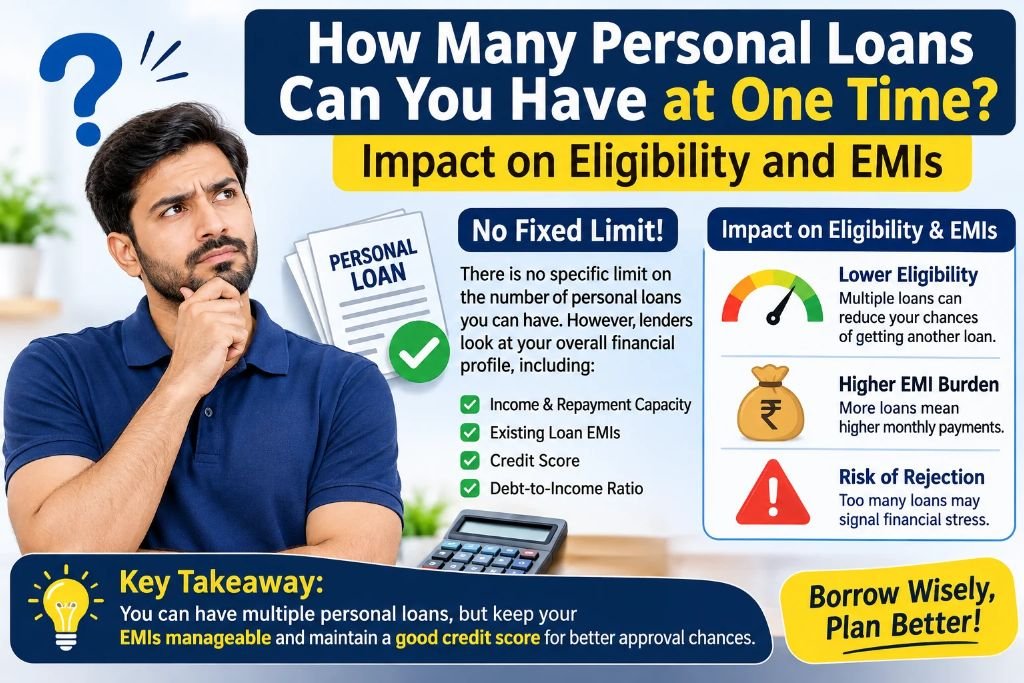
There is no legal limit on how many loans you can apply for, though approval will depend entirely on your credit profile. Approvals of a personal loan come down to the credit score and debt-to-income ratio (DTI) of the applicant. Multiple application always triggers hard inquiries, which will take off CIBIL score points, making the applicant less eligible for future loans. A lower CIBIL score causes the applicant to pay higher interest rates, making the EMI amount higher.
Introduction
At times, one credit isn’t enough, especially when one cash need shows up after the other. And if you are currently not handling a loan, or maybe you are handling one or a few, you might be wondering how far the borrowing capacity can stretch.
But it’s not just about being approved, but also about how it impacts your CIBIL score and if it is something your budget can handle.
The guide helps you understand what it is about if you apply for multiple loans and how it collectively impacts your credit profile for both the short and long run.
What Happens If You Apply For Multiple Loans At Once?
If you view it solely from a regulatory standpoint, there is no limit to how many applications you can apply for. Although there is no law or banking regulation that will prohibit you from doing so, it is not advised, considering the long-term health of the candidate.
If your budget allows, you can opt for multiple applications, though something to note is that the algorithms check if you can pay the loan easily with your ongoing EMIs from your take-home pay; only then will your request is approved.
So, just in case your applications do not get approved, it will still impact your credit profile because an application triggers a hard inquiry, which takes off some points from your CIBIL score.
What Will Be The Impact On The Eligibility And EMIs Of Multiple Applications?
Even if you pass the multiple personal loans eligibility criteria, taking on a further personal loan has a massive impact on your financial profile because it has a dual effect: it can damage your long-term borrowing capacity and put real strain on your monthly cash flow.
The Debt-to-Income Strain (FOIR):
Lenders assess your eligibility via the Fixed Obligation to Income Ratio (FOIR), which is the ratio of your total monthly debt payments to your net monthly income. Most lenders will be very keen for your FOIR to be below 40% to 50%.
As your loans start to pile up, so do your EMIs, which takes you further away from the safe criteria of FOIR. This automatically makes you less eligible if you plan to apply for a loan even further.
Take a monthly take-home of ₹50,000 as an example. The lenders will want your total EMIs to be somewhere in the region of ₹20,000 to ₹25,000. Once you go beyond that point, your eligibility for any other loan in the future is effectively shot until you fully repay the previous payments. The underwriting algorithms will automatically flag you as being overleveraged and will assume you have no buffer at all to fall back on in the event of an emergency.
Impact on the EMI
Personal loans are unsecured and have no collateral to fall back on as a backup, because of which the interest rates will vary as per how secure your credit profile seems to the lender. If you have several personal loans, then you’re effectively managing a number of separate repayment cycles.
This compounding effect leaves you with absolutely minimal disposable income at the beginning of each month. If you have any unforeseen expense, your cash flow is so tight that you’re in real danger of missing an EMI. A single missed payment across any of these loans triggers heavy penalty fees, which instantly damage your credit score and leave a mark on your credit profile for up to 7 years, taking a significant chunk of your borrower credibility.
What Approach Is Best To Apply And Keep Your Credit Profile Healthy?
If you genuinely do need more money on top of an active personal loan, then you need to plan your approach carefully in order to protect your financial position while qualifying for multiple personal loans eligibility.
- It is better to always space out your applications rather than applying for a loan one after the other. Wait at least 6 months between requests to give your credit score time to recover from the previous hard inquiry.
- It is better to choose more credible lenders than what you think might be an easy apply, since top lending services are always clear with their terms and conditions and charge no hidden fees.
- If you have any previous loans which are still ongoing, pay them off first, then apply for another one to avoid any further piling up of the EMIs.
- Maintain a debt buffer so that even after you’ve taken on a new loan, your total monthly debt payments don’t exceed 40% of your take-home pay.
To Sum Up
You can in fact hold multiple personal loans at the same time, but that obviously requires great financial discipline as well as budgeting. The point isn’t so much how many personal loans you can get as it is how you can manage the repayment without exhausting all your monthly pay, leaving you nothing in your account. The key is to keep your debt-to-income ratio as low as possible.
The best approach is to first check eligibility on a personal loan platform and pick the one that aligns with you, but the key is to pick one with higher levels of credibility, like Finnable, which is one of the popular options, offering loans up to ₹10 lakhs while approving your request in minutes and offering personal loan EMI calculation to give you an estimate of your payments.