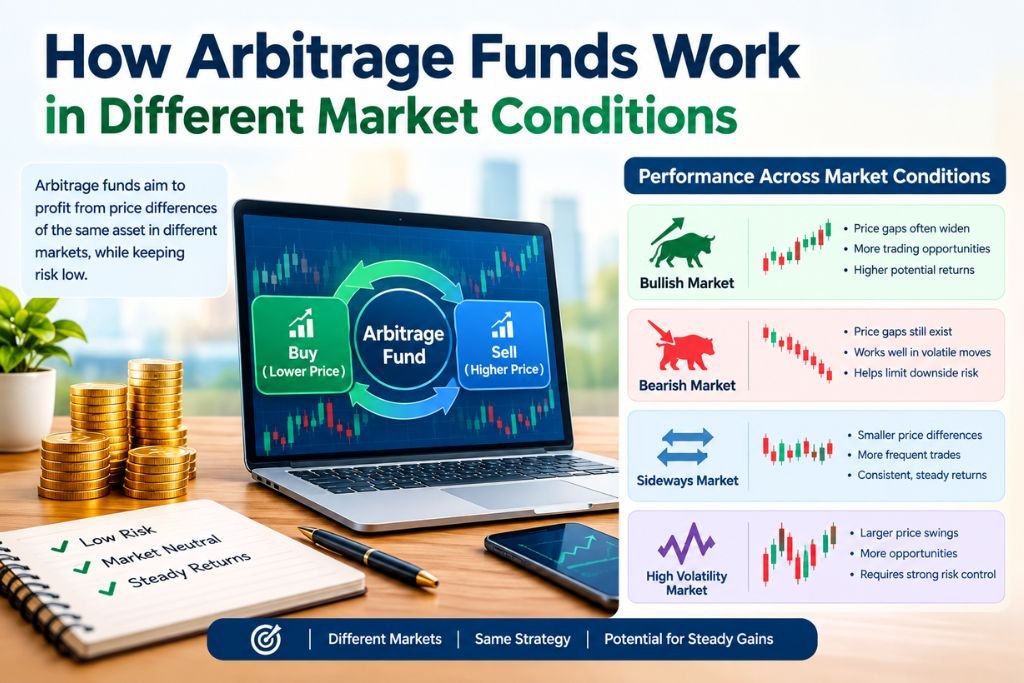
Markets have this odd habit of pricing the same stock slightly differently across two exchanges for a few fleeting seconds. Most retail investors never notice this gap. Fund managers running an arbitrage fund, however, build their entire strategy around catching exactly that.
What Actually Happens Inside These Funds
An arbitrage fund is a fund that is involved in purchasing a stock in the cash market and selling the same stock in the futures market for a profit. It seems so straightforward, and it is; but individual investors don’t typically have the speed and volume that is necessary.
This is why so many people end up choosing a professionally managed scheme over trying this on their own trading account. Fund houses have the systems, the capital, and the timing infrastructure to execute thousands of these trades daily without breaking a sweat.
Bull Markets Versus Sideways Markets
Now the fun begins. An arbitrage fund is likely to do a little better when markets are volatile or when the markets are trending in a particular direction. Why? The wider the spread between the futures and cash prices is, the more opportunity it will provide fund managers to take advantage of it as uncertainty increases.
In sideways markets, the opposite occurs when markets are calm. The discrepancies in price diminish, opportunities become more limited, and the returns on and out of an arbitrage fund can become quite modest, and sometimes even less than the returns from a savings account. This doesn’t mean the strategy has failed. In other words, the fundamentals of the market that create an opportunity for arbitrage have somewhat subsided.
Why Investors Still Hold Onto Them
Despite these swings in performance, plenty of conservative investors keep a portion of their portfolio parked here. The reasoning is fairly straightforward. Since the buy and sell positions offset each other, the strategy carries relatively low market risk compared to a pure equity fund, while still enjoying equity taxation benefits under current rules.
This blend of safety and tax efficiency is exactly why fund houses like ICICI Mutual Fund have built dedicated schemes around this category. ICICI Mutual Fund happens to be one of the larger and more established names offering this kind of product, giving investors a reasonably long track record to study before committing money.
A Quick Word on Timing Your Entry
Investors sometimes ask whether there’s an ideal moment to enter this category. Honestly, since returns depend heavily on market volatility rather than direction, timing matters less here than it does with equity funds. Entering during periods of heightened market activity, say around results season or major policy announcements, often works in an investor’s favor since spreads tend to widen during these windows.
Comparing Options Before You Commit
If you’re evaluating where to park short term money, comparing a couple of schemes side by side makes sense before settling on one. Looking at how ICICI Mutual Fund’s offering has performed across both calm and volatile periods gives a fairly balanced picture, rather than judging it purely on one good quarter.
Wrapping This Up
At the end of the day, this category isn’t built for explosive growth. It’s built for investors who want equity like tax treatment without equity like volatility. Understanding how these funds behave differently depending on whether markets are choppy or calm helps set the right expectations before you invest a single rupee. (You are recommended to seek advice from a financial advisor before you take any or refrain from any action)