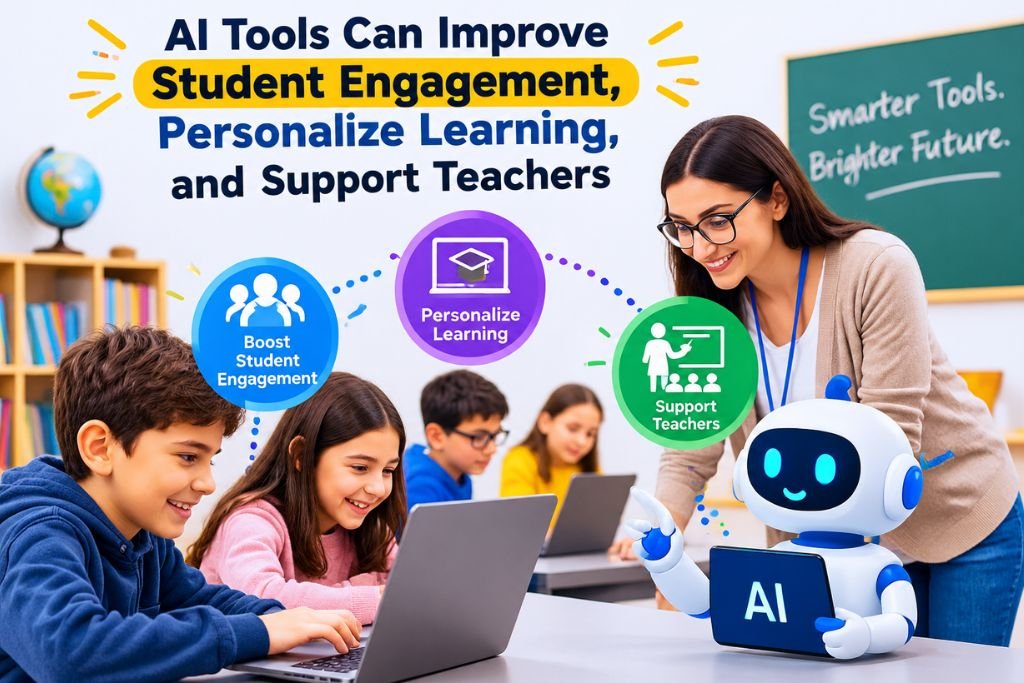
Technology is changing the way students learn and teachers teach. Besides, artificial intelligence (AI) can be employed in various ways to engage students, address their individual needs, and facilitate teacher instruction.
By offering interactive activities, practice tools, and providing additional resources, AI can make learning appealing, personalize the educational process, and assist teachers in their work.
Making Learning More Interesting
It can be challenging to make learning appealing to students as one class includes pupils with varying interests and abilities. While traditional methods remain relevant, games and interactive activities can be used to attract students’ attention and raise their learning enthusiasm.
Interactive educational tools powered by AI can make the process of obtaining knowledge entertaining as they propose quizzes, practical tasks, various activities, and provide explanations. The teacher can also apply digital resources to demonstrate the material in an interesting way, for instance, by presenting the solar system and discussing the movement of planets using interactive tools. Such tools will engage learners in the educational process, enabling them to participate actively. Moreover, interactive activities allow the teacher to assess the students’ understanding of the given material.
When students find the process of learning interesting and involving, they are more likely to ask questions, share their ideas, and actively engage in the educational process.
Supporting Personalized Learning
The traditional educational setting is quite uniform as it offers the same explanations, presentations, and tasks to students, irrespective of their abilities and understanding. However, it may be challenging for some pupils to learn at the same pace as their classmates. In such cases, personalized learning can be beneficial for both the students and the teacher.
Some AI-based educational tools offer a personalized learning experience by suggesting various tasks, additional explanations, and practical material according to the learner’s progress.
For instance, when a student struggles to understand fractions, a learning assistant can offer simple explanations and provide examples. At the same time, another student can move to the next level and solve more complicated tasks. Such AI-powered tools can help learners get the necessary knowledge without being distracted by the classmates’ progress. However, it is crucial that the teacher monitors the students’ progress to ensure that the tools are used correctly and everyone receives the required support.
Helping Teachers Prepare Lessons
The preparation of teaching strategies, presentation of material, tasks and assignments, as well as the correction of students’ work consumes a lot of a teacher’s time. However, some educational tools powered by AI can help in preparing the classes and make the teaching process more effective.
The tools can help the teacher come up with ideas for the lesson plan, suggest questions for the quiz, offer examples for the students’ practice, and provide the necessary information in an organized manner. Additionally, such tools can be used to differentiate the material according to the students’ abilities and provide individual recommendations.
For instance, when preparing a lesson plan for a history class, the teacher can use an AI-powered tool to come up with questions for a quiz or get a detailed presentation of the main points of the lesson. Then, the educator can edit the proposed material and present it in a way that would be easy to understand by the students. By delegating some time-consuming tasks to AI-powered tools, the teacher can devote more time and energy to teaching the students directly, providing individual help or developing their soft skills.
Improving Feedback and Student Progress
Providing students with feedback is essential as it helps them reflect on their progress, detect their strengths and weaknesses, and improve their performance. Moreover, such feedback can be used by the teacher to determine the students’ progress and address gaps in their knowledge. When it comes to multiple-choice questions and specific tasks, some AI-based tools can provide immediate feedback. The learners can see their mistakes, reread the relevant material, and repeat the task to ensure that they have mastered the necessary information. In such a case, the feedback would be helpful for both the student and the teacher.
In addition, such tools can be used to determine common mistakes and support the teacher in addressing them. However, the validity of the feedback provided by such tools should be checked by the teacher, as it may contain errors. Thus, while AI tools can be used to monitor the students’ progress, the teacher should supervise the process and ensure that it is accurate.
Using AI Tools Responsibly in Education
The use of AI in education can be beneficial for students, teachers, and the overall learning process. However, the tools should be used responsibly as they may provide incorrect information and encourage students to rely on them excessively. Educational institutions should ensure the students’ data security and privacy and only use reliable tools. Additionally, pupils should have equal access to the resources provided by such tools.
Moreover, the tools should be used to complement the learning process, not replace it. Students must continue to think critically and develop their soft skills, including social ones, as they will still need them in the future.
Conclusion
AI tools are being used in a variety of fields, including education, as they offer numerous benefits. When it comes to the educational setting, the tools can be used to get support, obtain additional explanations, and practice new skills. They can also be used by the teacher to determine students’ strengths and weaknesses, provide feedback, and differentiate the material according to the students’ abilities. However, such tools should be used responsibly and should only complement the learning process.